
The month of April has been unusual, with McGill cancelling multiple sessions as they needed time to go back and reevaluate their position. This followed March, where the Unit 3 bargaining committee tabled its monetary proposal and McGill responded with a wage offer that was not only a real wage pay cut, but furthermore, a pay scale that would allow your wages to be decided arbitrarily by the manager. First, we will cover our session with the McGill Writing Centre (MWC) on March 25th before discussing our latest (brief!) bargaining session on April 29 that saw McGill cave in to some of our demands at the table.
March 25, 2026
First, McGill came to this session with a counterproposal regarding leaves policy (Article 15). The main point of the counter proposal was to scrap much of the language that the bargaining committee proposed, which focused on either replicating the leaves policy seen in the Teaching Assistant (Unit 1) agreement or other leaves that may have been enjoyed by MWC workers before unionization.
Instead, their proposal largely referenced the Act respecting labour standards and the Act respecting parental insurance. This is problematic in that a collective agreement helps enshrine certain protections above the legal minimum, and is best tailored to the working environment. Furthermore, clearly defining protections like leaves in the collective agreement is important for protecting against changes in the legal code that take away rights, which has been happening consistently with the current government.
At this session, we also had a dedicated discussion about the MWC. For background, MWC workers were certified in January 2025 and formally merged into Unit 3 in March 2025. This group is a very unique part of Unit 3, covering a broad range of workers at various academic levels, ranging from graduate students to people who already hold their PhD. There are currently five positions, with some like the MWC Fellow and MWC Tutor roles being quite flexible and shorter-term, while other coordinator roles are closer to more permanent positions.
To help both sides better understand how the MWC functioned, the employer brought in a manager from the unit. Both sides asked questions to better understand the MWC’s hiring practices, how work is distributed across the unit, and about the MWC’s working conditions more broadly. While both sides found the session useful, the employer noted they will still need additional time to better understand the MWC.
In attendance on our side of the table were Emma Moore (4th Year, Industrial Relations), Donald Morard (PhD Candidate, Grader, History), Jordan Cowie (2L Faculty of Law), Dallas Jokic (President, PhD Candidate, Philosophy), and Guillaume Forest-Allard, our advisor from our affiliate union Fédération nationale des enseignantes et des enseignants du Québec (FNEEQ). We were also joined by five members for open bargaining.
April 29, 2026
After a month of not bargaining, McGill returned to the table for a brief bargaining session with critical updates regarding position definitions (Article 11) and some news regarding wage scales. While these were only given to us verbally, with a promise to provide written proposals at the next bargaining session on May 6, this nevertheless signifies a big shift since last month.
First, McGill accepted our language that course assistants would be hired only as undergraduate students. This is a big win as it helps delineate the differences between course assistants and teaching assistants, something which we have been pushing McGill on for many bargaining sessions.
McGill’s offer regarding graders has also moderately shifted; while McGill is unwilling to restrict graders to just undergraduate students, they did agree to ensure it was only students who could fulfill these roles. As mentioned in Newsletter 18, this is a win for protecting jobs on-campus for McGill students. This is especially important for international students, who now face greater restrictions on working off-campus. As mentioned in our previous newsletter, in the narrow cases where the university may need to hire individuals who are not current students, the union and the university can sign a letter of agreement to allow these hires.
Lastly, McGill said they are reviewing the possibility of a wage offer with fixed wages. While this falls short of our red line against pay scales, it does indicate a step in the right direction. We hope McGill will offer a deal that offers a fixed rate, which is standard practice in collective agreements for workers at other universities working similar jobs.
Although the meeting was brief, at just around an hour, it was nevertheless a sign of positive progress. There is still much to be done, particularly around McGill’s below-inflation wage offer and the non-transparent pay scales. Furthermore, at the bargaining session, McGill only verbally offered the above items, promising to give a concrete offer on positions at our May 6 bargaining session. If you want to see what’s next, attend the next bargaining session!
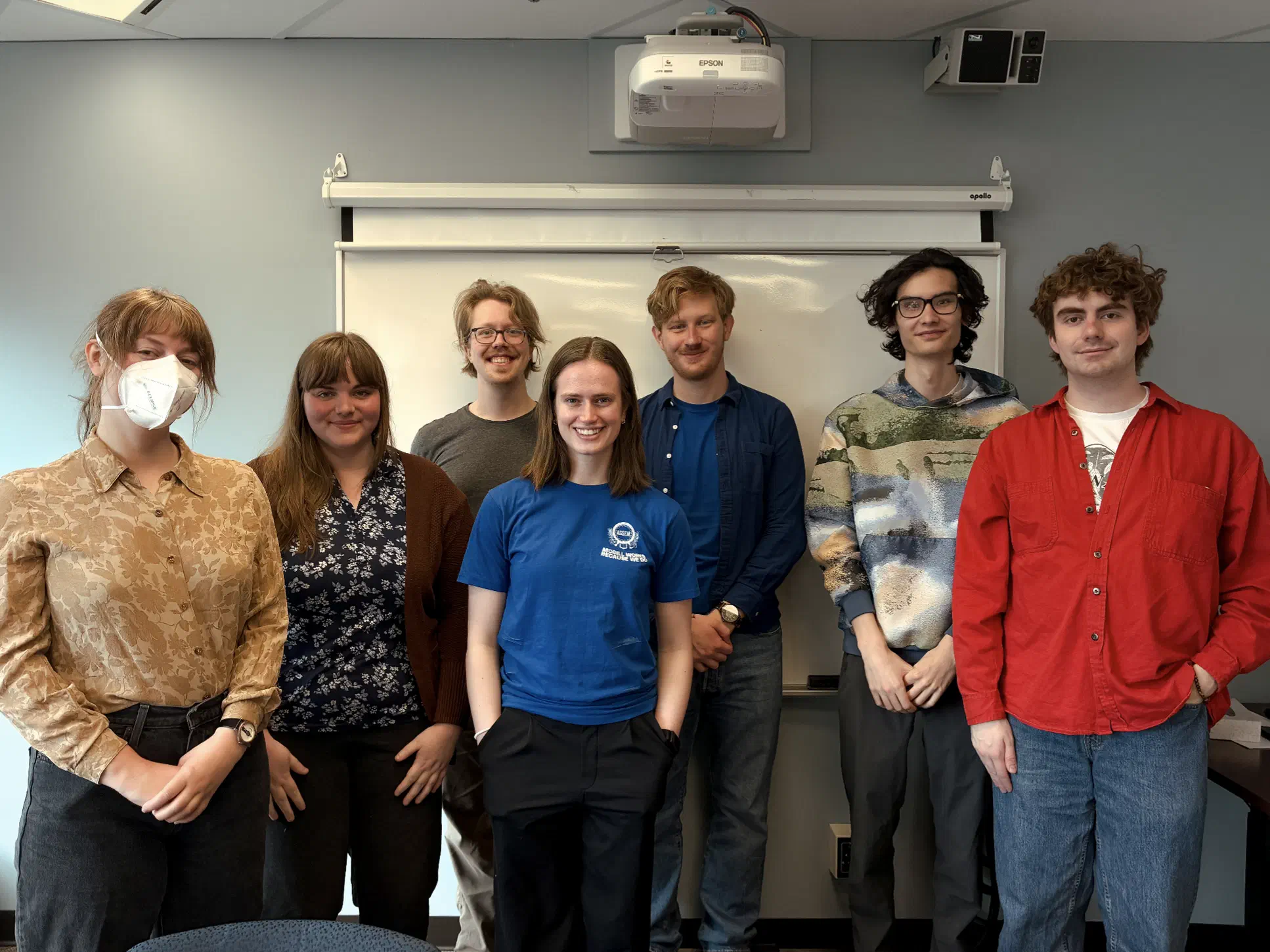
On our side of the table were Emma Moore (4th Year, Industrial Relations), Donald Morard (PhD Candidate, Grader, History), Jordan Cowie (2L Faculty of Law), Ari Blondal (incoming President), Connor O’Keefe (outgoing U3 Grievance Officer), Grey Lorbetskie (incoming U3 Grievance Officer), and Guillaume Forest-Allard, our advisor from our affiliate union Fédération nationale des enseignantes et des enseignants du Québec (FNEEQ).
Do you have thoughts and insights to provide (of course you do!)? Please don’t hesitate to reach out to bargaining.casual1@agsem-aeedem.ca with your insights, questions, or concerns!
Love and solidarity,
Your Bargaining and Bargaining Support Committee